 planwithzen
Highest interest first
Prioritize the debt with the highest annual percentage rate. This approach typically reduces estimated interest when payment amounts and other assumptions remain consistent.
Organize credit cards and loans, choose how much you plan to pay, and see estimated payoff dates and interest based on the information you enter.
Self-directed financial planning tools for educational purposes only. Not financial, investment, tax, or legal advice.
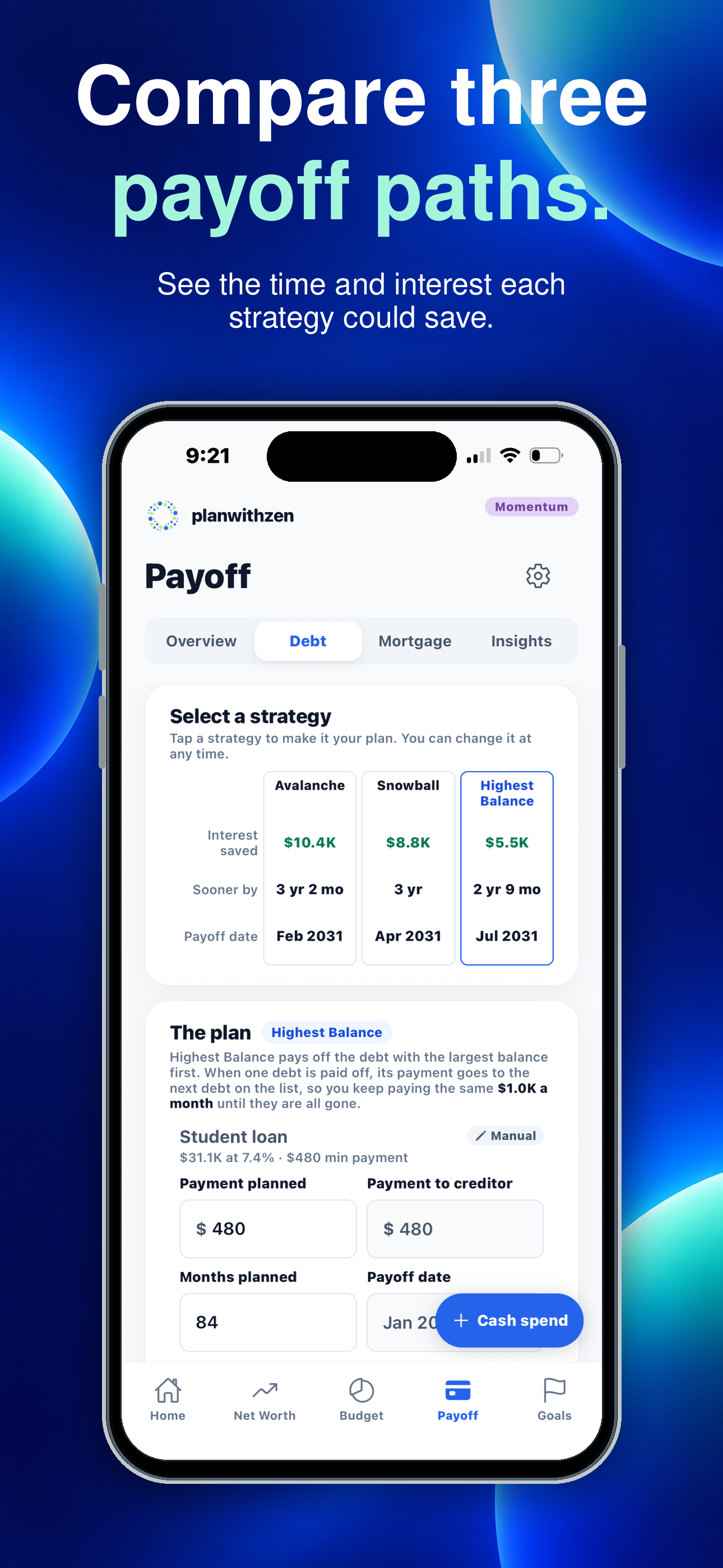
A plan you can understand
When one debt reaches zero, its planned payment can move to the next debt according to the payoff approach you select. The result is a month-by-month illustration—not a promise of a particular outcome.
Prioritize the debt with the highest annual percentage rate. This approach typically reduces estimated interest when payment amounts and other assumptions remain consistent.
Prioritize the lowest balance to create earlier payoff milestones. This Momentum approach may help some people stay engaged with the plan.
Prioritize the largest balance and compare its estimated timeline with the other Momentum approaches.
Consumer debt payoff for real life
Paying the minimum on everything keeps each balance alive for years. A payoff plan decides where anything above the minimum goes, and what happens to it when a debt clears.
Credit cards and loans, each with its balance, rate, and minimum payment.
Highest interest first on Free. Momentum compares that with smallest and largest balance.
When one debt is paid off, its payment moves to the next one in the order.
How consumer debt payoff planning works
Enter the current balance, interest rate, minimum payment, and any other requested details.
Set what you plan to pay each debt, at or above its minimum. The screen adds them up into your monthly total.
Use highest-interest-first with Free or compare three approaches with Momentum.
Consumer debt payoff features
Simple pricing
Free gives you a complete financial picture and practical plans. Momentum helps you keep those plans current and see how they change over time.
Free
Understand where you stand and build your first plans.
No subscription or bank connection required.
Momentum
Work your plans month after month and watch your progress.
Renews monthly until canceled. Manage or cancel through Apple ID settings.
| Capability | Free | Momentum |
|---|---|---|
| Manual financial tracking | ✓ | ✓ |
| Plaid account connections | — | ✓ |
| Monthly budget | 2 months | 6 months |
| Actual-versus-budget comparison | — | ✓ |
| Consumer debt payoff approaches | Highest interest first | 3 approaches |
| Mortgage-payoff plan | — | ✓ |
| Active financial goals | 2 | 10 |
| Custom categories | 4 | 10 |
| Current net worth and health score | ✓ | ✓ |
| Financial history | — | 6 months |
Payoff questions, clearly answered
No. planwithzen organizes information and produces educational estimates. It cannot transfer money or make payments.
Credit cards, store cards, auto loans, student loans, and personal loans. Enter each one with its current balance, interest rate, and minimum payment, and the plan orders them for you.
The plan and the budget use the same figures. Each debt’s minimum payment appears in your budget under its own category, and whatever your plan adds above the minimum appears under Debt payoff, in savings and debt payoff. You enter each amount once.
It typically produces lower estimated interest when the amounts and assumptions stay the same, but the approach that fits you depends on your circumstances and preferences.
No. Dates and interest are estimates based on the information and assumptions entered. Rate changes, fees, new charges, missed payments, or lender calculation methods can change the result.
Coming to iPhone
Order your debts, set a monthly payment, and see how the plan connects to your budget, financial goals, and net worth.
Related planning tools
planwithzen is coming soon to iPhone.